The Supplier Invoice Black Hole: Quantifying the Hidden Cost of Manual Processing
Economics
The Supplier Invoice Black Hole: Quantifying the Hidden Cost of Manual Processing
Even in highly efficient strata firms, manually processing inbound supplier invoices costs more than most managers realise. When you process 50,000 invoices a year at $5 to $7 each in data-entry labour alone, the numbers are substantial. This article breaks down the unit economics of manual AP versus API-driven automation, and explains how integrated work order systems transform invoice processing from a manual expense into a structured, data-driven workflow.
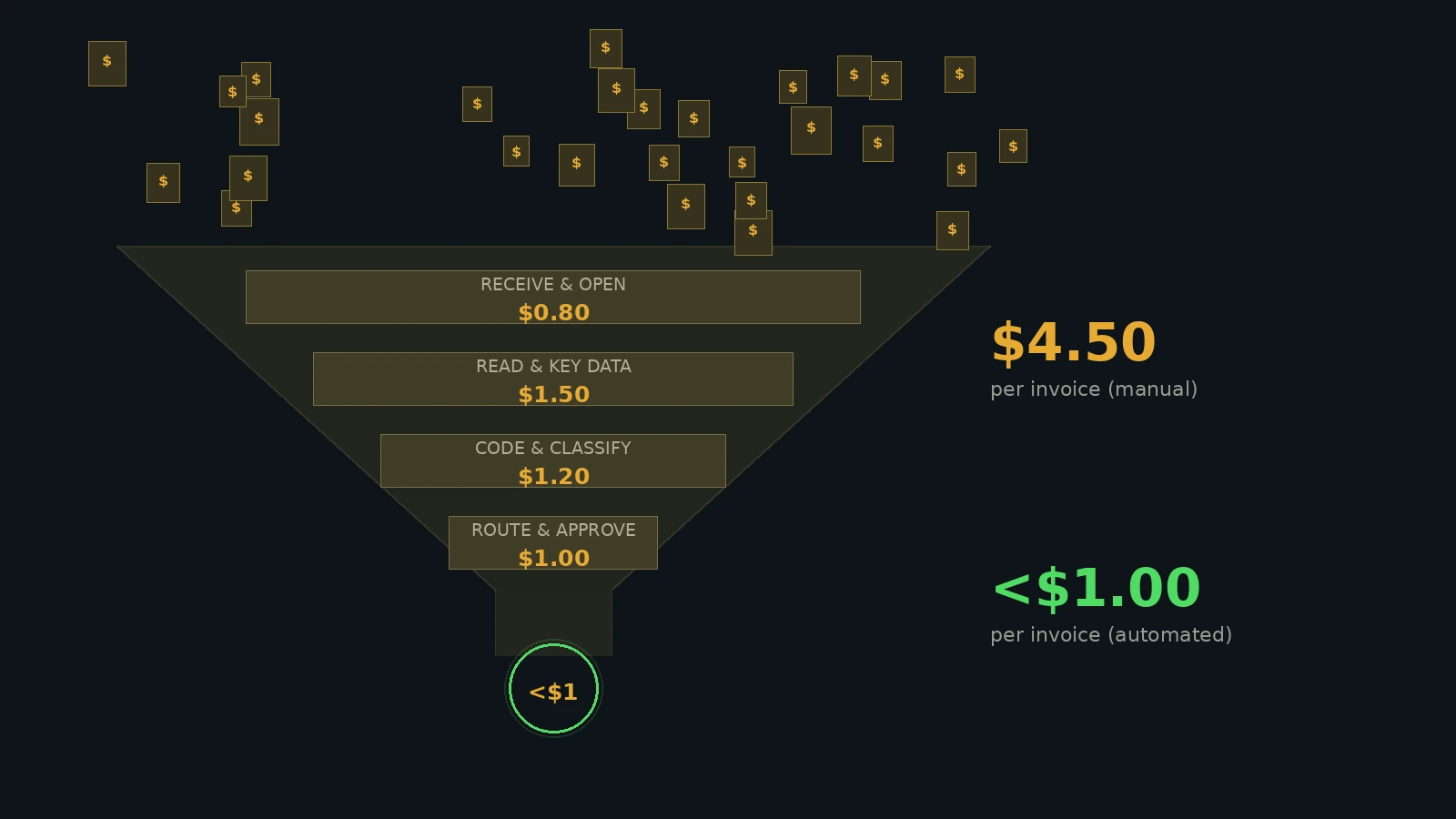
In the average strata firm, the Accounts Payable (AP) function quietly absorbs enormous operational effort. Invoices arrive via email, post, and portal, creating a fragmented flow that requires human intervention before the data reaches the finance system.
Even when internal processes are highly streamlined, someone still needs to open the email or attachment, review the PDF, enter supplier details, code the GL, attach the file, and push it into workflow. That touch time is not free.
The $300,000 Problem
Industry benchmarking suggests that manual AP data-entry touch alone typically costs between $5 to $7 per invoice in labour in Australia. This estimate excludes approval time and management review, it reflects only the Accounts Payable processing effort required to receive, interpret and enter invoice data into the system.
Annual AP Data-Entry Cost, Mid-Sized Strata Firm (50,000 invoices/year)
-
LOW ESTIMATEAnnual cost: $250,00050,000 invoices x $5.00 per invoice in labour time
-
HIGH ESTIMATEAnnual cost: $350,00050,000 invoices x $7.00 per invoice in labour time
That is a six-figure operational cost purely for moving data from PDF into software. It is important to acknowledge that many strata firms already operate efficient AP teams with structured coding rules and experienced staff. In such environments, data-entry time may sit at the lower end of the range.
However, even a well-optimised manual process cannot eliminate the fundamental reality: a human must read and re-key information that already exists in digital form.
A Broader Benchmark
For context, the Australian Taxation Office’s Peppol eInvoicing Value Assessment (prepared by Deloitte Access Economics) estimates that the total processing cost of a PDF invoice is approximately $27.67, and a paper invoice approximately $30.87. The report allocates roughly 60% of that cost to the Accounts Payable side of the transaction.
These figures include end-to-end effort, receipt, validation, review, approval and related overhead, not just data entry. Strata firms with disciplined internal workflows may sit below these broader cross-industry averages. But even if your AP touch cost is “only” $5 to $7, the aggregate impact remains material.
The "Source-to-Pay" Revolution
The solution is not faster typing. It is changing the source of the data. Modern, best-of-breed strata management platforms move the industry away from “reading PDFs” to “consuming structured data.”
Work Order Integration, when a Work Order for a Valuation, BHS Report, or Maintenance job is marked “Complete” by the supplier within the platform, the system can auto-generate the supplier invoice. The data does not need to be read; it is already known.
Insurance Automation, renewals and endorsements received via structured integration channels can update policy data automatically and pass invoice data directly to the finance system.
Revenue Event Automation, when a system applies a late payment penalty to a lot owner, it can simultaneously generate the corresponding supplier or revenue invoice for the firm, without manual re-entry.
Verification at Scale
Speed means nothing without security. Best-of-breed strata management platforms offer integration to third-party verification services (such as Eftsure) directly within the payment workflow. Before an invoice reaches the approval queue, supplier identity and bank details can be validated against national registries. This reduces fraud exposure while eliminating repetitive validation work.
The Enterprise Advantage
If manual AP touch costs $5 to $7 per invoice, and API-driven automation reduces that to under $0.50 in system-level processing cost, the economics are clear.
Supplier Invoice Processing, Annual Cost Comparison (50,000 invoices)
- Received via email, opened by human, PDF reviewed, supplier details entered, GL coded manually, file attached, pushed to workflow
- Received via API/Work Order, data extracted automatically, GL coded from history, supplier verified against registry, routed for one-click approval
That delta represents a potential six-figure productivity shift, without increasing headcount, and without signing a single new client. Automation does not make your team redundant. It removes the black hole so your team can focus on value, not transcription.