The Onboarding Trap: Why the First 48 Hours Define the Next 12 Months
Operations
The Onboarding Trap: Why the First 48 Hours Define the Next 12 Months
Every levy notice, every payment reference, every welcome pack inherits whatever data quality was established at go-live. When onboarding is treated as an admin task instead of a risk management function, the cost of a single missing field compounds across every automated workflow for the life of the building.
When a strata agency wins a new building, the celebration is brief. What follows is a race against time: import the lots, set up the owners, configure the financials, and get the first levy run out the door. In most firms, this is treated as a data-entry exercise, a box-ticking sprint handled by the most junior person available.
That is a mistake. Because every field entered, or missed, during onboarding will echo through every automated process for the life of that building.
The Compound Error Problem
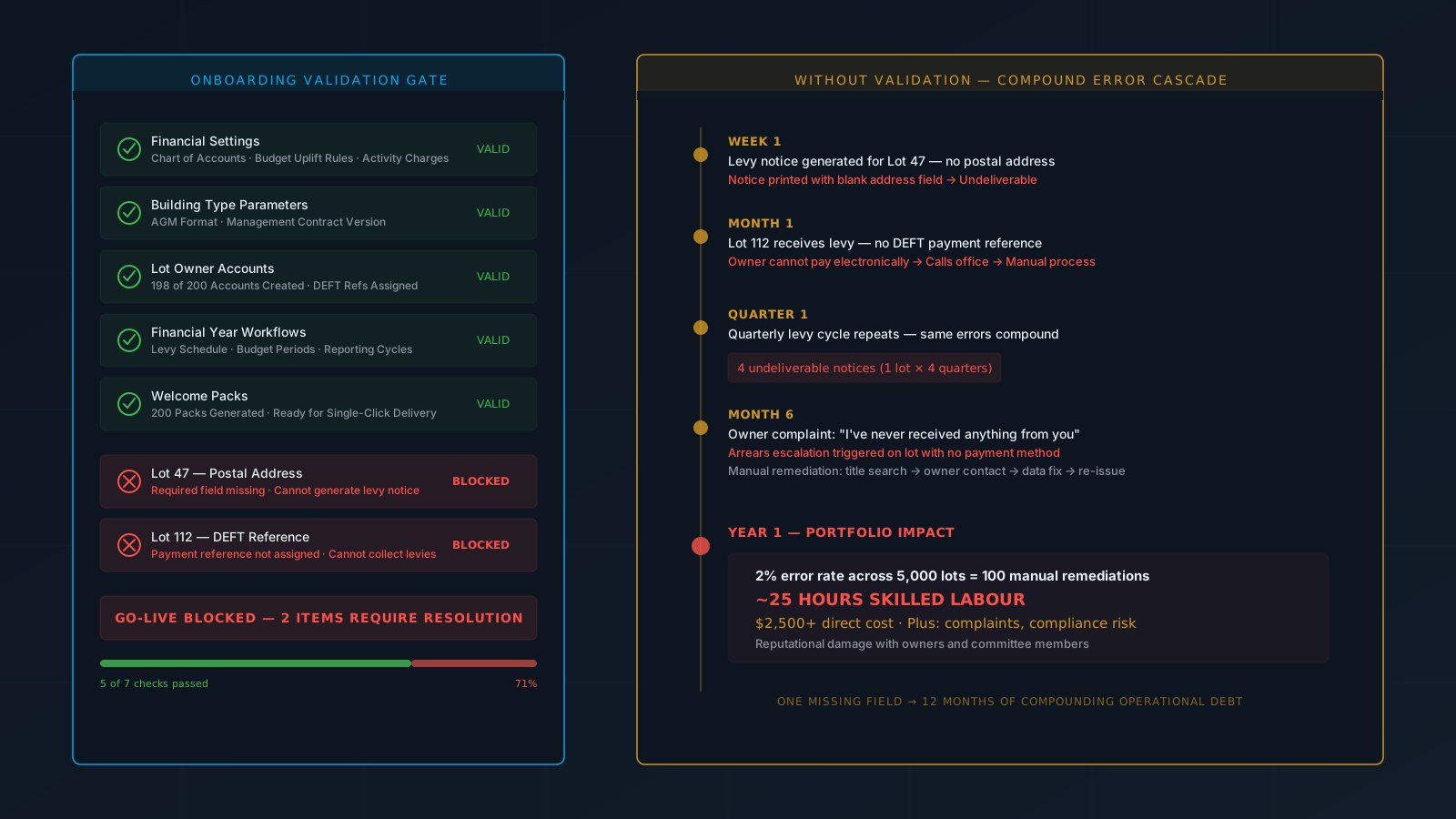
Consider a simple omission: a lot owner’s postal address is left blank during setup. In a manual environment, someone might catch it when they print the first levy notice. In an automated environment, the system doesn’t pause to check, it generates, prints, and dispatches. The result? A levy notice with no delivery address. Multiply that by a quarterly cycle across a 200-lot building, and you have 800 undeliverable notices per year from a single missing field.
Now extend the logic. A missing DEFT payment reference means the owner has no way to pay electronically. A wrong lot entitlement means every levy calculation is incorrect from day one. A wrong email address means the owner never receives their welcome pack, their meeting notices, or their correspondence, and in systems that rely solely on email delivery, or that lack an automated postal failover, the agency may never know. The system recorded a “successful” send to what looked like a valid address.
This is the Compound Error Problem: a single onboarding deficiency doesn’t create one error, it creates a recurring error that multiplies across every downstream workflow.
The "Go-Live Gate" Principle
The traditional approach to onboarding is permissive. Most platforms allow you to create a building and immediately start operating, even if critical data is incomplete. The assumption is that the manager will “come back and fix it later.”
They rarely do.
Best-practice platforms take the opposite approach: validation-gated go-live. The principle is simple, a building cannot enter live operation until every mandatory field has been validated and confirmed. This includes financial settings such as the Chart of Accounts, budget uplift rules, and activity charges. It includes building-type parameters like the AGM format and the applicable management contract version. And it includes every lot owner’s postal address, communications preferences, lot entitlement, and payment reference.
The validation gate doesn’t slow the agency down. It prevents the agency from inheriting a portfolio of data debt that will cost far more to rectify than it would have cost to enter correctly in the first place.
What Best-Practice Onboarding Actually Triggers
In a validation-gated system, creating a new building isn’t just a data import, it’s an orchestrated sequence of automations that fire in a specific order.
What Best-Practice Onboarding Actually Triggers
-
STEP 1Default ConfigurationFinancial settings, Chart of Accounts, budget uplift rules, activity charges, and building-type parameters (AGM format, management contract version) are applied from pre-configured templates. The defaults are set once by the Principal and inherited by every new building, eliminating the risk of a manager manually selecting the wrong setting.
-
STEP 2Financial Year GenerationThe inaugural financial year workflows, levy schedules, budget periods, and reporting cycles, are generated automatically based on the onboarding parameters. There is no manual calendar setup.
-
STEP 3Lot Owner Account CreationLot owner accounts are created (or, if the owner already exists in another building, linked to the existing account). Each owner is assigned a unique electronic payment reference, ensuring a valid, traceable payment path from the moment the first levy is issued.
-
STEP 4Welcome Pack GenerationPersonalised welcome packs are assembled for single-click delivery, a personally addressed welcome letter, pre-populated communication contact details confirmation, the building's Client Information Sheet, the applicable Model Rules (or building-specific rules if on file), the Insurance FSG, and a tailored introduction to the management platform. The same workflow applies to change-of-ownership scenarios.
-
STEP 5Mandatory ValidationAll mandatory and recommended go-live parameters are validated and reported. Any gaps, a missing postal address, an unconfirmed lot entitlement, a missing payment reference, are flagged and must be resolved before the system permits live operations.
-
STEP 6Parameter LockOnce validated and activated, onboarding parameters are locked to prevent accidental modification that could disrupt live workflows.
The Owner's First Impression
There is a secondary benefit to validation-gated onboarding that most agencies overlook: the owner experience.
When an owner receives a professionally assembled welcome pack, personally addressed, with their communication preferences confirmed, their payment method established, and their building’s rules and insurance documentation enclosed, they form an immediate impression of the agency’s competence. This is the first touchpoint in the relationship, and it sets the tone for every interaction that follows.
Contrast this with the alternative: a generic email with a PDF attachment, sent three weeks after settlement, with a “please call us to set up your account” instruction. One approach says “we have this under control.” The other says “we’re still catching up.”
The most progressive agencies are now extending this principle to self-service lot owner onboarding, giving owners the ability to activate their portal access independently. This reduces the administrative overhead of owner setup while simultaneously giving the owner a sense of agency and transparency from the outset.
The Hidden Cost of Retrofitting
The reason validation-gated onboarding matters is not philosophical, it’s economic. Retrofitting bad data is one of the most expensive and invisible costs in strata management.
Fixing One Missing Postal Address, 6 Months After Go-Live
- Identify the gap (usually after an owner complaint), locate correct address (title search or owner contact), update the record, re-issue affected correspondence, log the remediation
- Field flagged as incomplete during onboarding, manager resolves before go-live, all downstream workflows inherit correct data from day one
Across a portfolio of 5,000 lots with even a 2% error rate, that’s 100 lots requiring manual remediation, roughly 25 hours of skilled labour spent fixing something that should never have been wrong.
Now multiply that across every field type, payment references, entitlements, email addresses, building-type settings, and the scale of the problem becomes clear. Agencies that treat onboarding as an admin task are quietly building a backlog of data debt that erodes their operational efficiency for years.
The Bottom Line
Onboarding is not a data-entry task. It is the foundation layer upon which every automated workflow, levies, correspondence, meetings, compliance reporting, owner communications, depends. The quality of data established in the first 48 hours determines the reliability of every process that follows for the next 12 months and beyond.
Best-practice firms are recognising this by adopting validation-gated onboarding: systems that refuse to go live until every critical field is confirmed, every default is applied, and every owner has a complete, verified record. The result is fewer errors, fewer complaints, lower remediation costs, and a professional first impression that sets the tone for the client relationship.