Technology
The Integration Imperative: Why Your Strata Platform's Connectivity Matters More Than Its Feature List
The strata platforms that win in 2026 aren’t the ones with the longest feature list, they’re the ones that connect intelligently to the banks, suppliers, government registries, and owner services that already exist. As the Australian ecosystem moves toward open banking, eInvoicing, and digital registries, the architecture of your platform matters as much as the functions inside it.
For two decades, strata software vendors have competed on features. More screens. More buttons. More modules bolted onto a monolithic core. The pitch has always been the same: “We do everything, so you don’t need anything else.”
That pitch is breaking down. Because in 2026, the most valuable capabilities in a strata manager’s workflow don’t live inside their platform at all. They live in the bank’s API. In the supplier’s invoicing gateway. In the government’s digital registry. In the owner’s payment network.
The question today isn’t just “what does your platform do?” It’s also “what does your platform connect to?”
The Monolith Problem
A monolithic platform is one that attempts to handle every function internally, from trust accounting to document storage to owner communications to supplier payments. On the surface, this seems efficient. One login, one database, one vendor.
In practice, it creates a closed ecosystem. The platform becomes the bottleneck. Every new capability, a new bank feed format, a new government reporting requirement, a new supplier invoicing standard, requires the vendor to build it, test it, and release it. If the vendor is slow, or if the requirement is niche, the agency waits. Or worse, the agency builds a manual workaround, re-introducing the very data entry that automation was supposed to eliminate.
The alternative is a connected architecture: a platform designed from the ground up to exchange data with external systems, ingest structured information from trusted sources, and push outputs to the channels where they’re needed.
Where Connected Architecture Already Delivers
The shift to connected ecosystems isn’t theoretical. It’s already reshaping daily strata operations in measurable ways.
Connected Architecture, Integration Impact
-
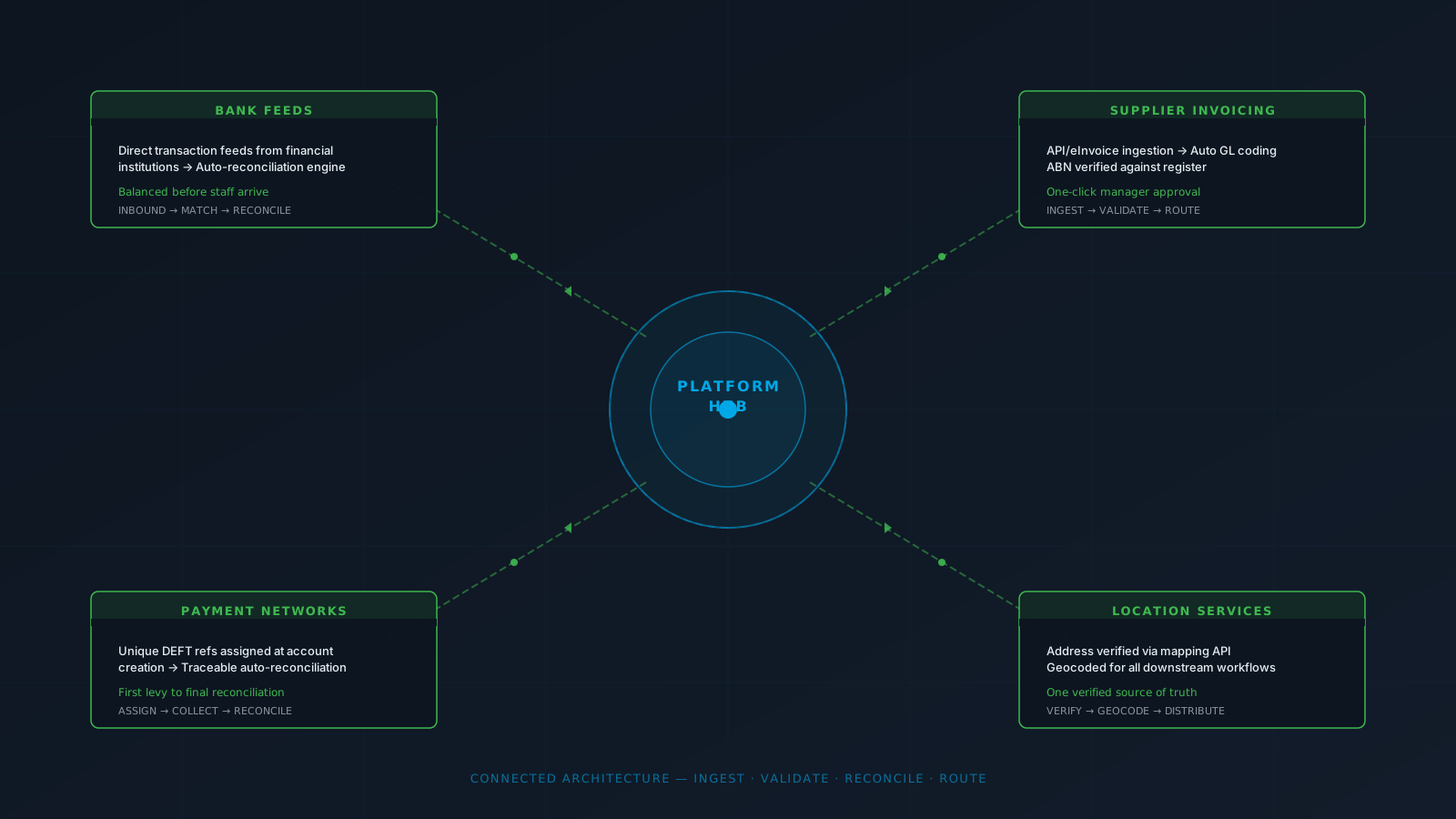
BANK FEEDSAccuracy depends on the connection, not the internal featuresModern trust accounting doesn't start with a human opening a bank statement. It starts with a direct data feed from the financial institution into the platform's reconciliation engine. Transactions are matched, categorised, and reconciled before the trust accountant opens their screen in the morning.Accuracy depends on the connection, not the internal features
-
SUPPLIER INVOICINGPlatforms that can't are asking staff to re-key data that already exists in digital formThe ATO's push toward eInvoicing (based on the PEPPOL framework) is accelerating the shift from PDF-based invoice processing to structured, machine-readable data exchange. Platforms that can ingest invoice data via API, extracting amounts, ABNs, GL codes, and work order references automatically, eliminate the manual data entry that currently costs enterprise firms $4 to $7 per invoice in labour alone.Platforms that can't are asking staff to re-key data that already exists in digital form
-
PAYMENT NETWORKSTraceable from first levy to final reconciliationPlatforms connected to electronic payment networks can assign unique payment references at the point of owner account creation, ensuring that every payment is traceable and automatically reconciled from day one. Platforms that rely on manual BSB/account number entry are creating reconciliation ambiguity that compounds with every payment cycle.Traceable from first levy to final reconciliation
-
LOCATION SERVICESOne verified source of truth for all location-dependent workflowsVerifying a building's address against a mapping API at the point of onboarding ensures that every downstream process, owner correspondence, contractor dispatch, emergency contact routing, is working from a verified, geocoded location. Without that connection, the platform is trusting whatever the human typed into the address field.One verified source of truth for all location-dependent workflows
The "Ecosystem" Mindset
The best way to understand connected architecture is to think of a strata platform not as a product, but as a hub, a central orchestration layer that coordinates data flows between the agency, its owners, its suppliers, its banks, and its regulators.
In this model, the platform’s job is not to replace external systems. It’s to connect them, letting each system do what it does best while the platform orchestrates the data that flows between them. Validating it, routing it, reconciling it, and presenting it to the manager in a unified operational view.
This is a fundamentally different design philosophy from the monolith. And it has a direct impact on the agency’s ability to scale, because every new integration reduces a manual touchpoint. Every manual touchpoint removed is labour recovered. And labour recovered is margin protected.
Why Feature Lists Are Misleading
When evaluating strata platforms, most agencies compare feature lists. Platform A has 200 features. Platform B has 180. Platform A must be better.
But this comparison misses the point. A platform with 180 features and deep connectivity to banks, suppliers, payment networks, and government registries will outperform a platform with 200 features that operates as a closed loop, because the connected platform is eliminating manual data entry at every integration point, while the closed platform is merely digitising it.
Platform Evaluation, Features vs Connectivity
- 200 features, all data entered manually, bank statements uploaded as files, invoices re-keyed from PDFs, payment references managed in spreadsheets, address data trusted on input
- 180 features, bank feeds reconciled automatically, invoices ingested via API, payment references assigned at account creation, addresses verified against mapping services, data flows in, not re-keyed in
The question to ask isn’t just “how many features does it have?” It’s “how can this platform and its connected ecosystem supercharge my operations and deliver better customer outcomes?”
The Bottom Line
The strata technology landscape is shifting from closed, monolithic platforms to connected ecosystems. Banks are offering direct data feeds. Suppliers are moving to structured invoicing. Government registries are going digital. Payment networks are enabling traceable, automated collections.
The platforms that thrive in this environment are the ones designed to connect, to ingest, validate, reconcile, and route data from external sources rather than attempting to replicate those sources internally. For enterprise strata firms, this means that a platform’s integration architecture is becoming as important as its feature set.