Technology
From Chatbot to Colleague: What Agentic AI Actually Means for Strata Operations
The Macquarie Bank 2026 Benchmarking Report confirmed it: 80% of Australian strata businesses are now using AI tools, but 24% are deploying AI agents, autonomous systems that execute multi-step workflows with minimal human oversight. That 24% marks the beginning of a structural shift. This article separates the signal from the noise.
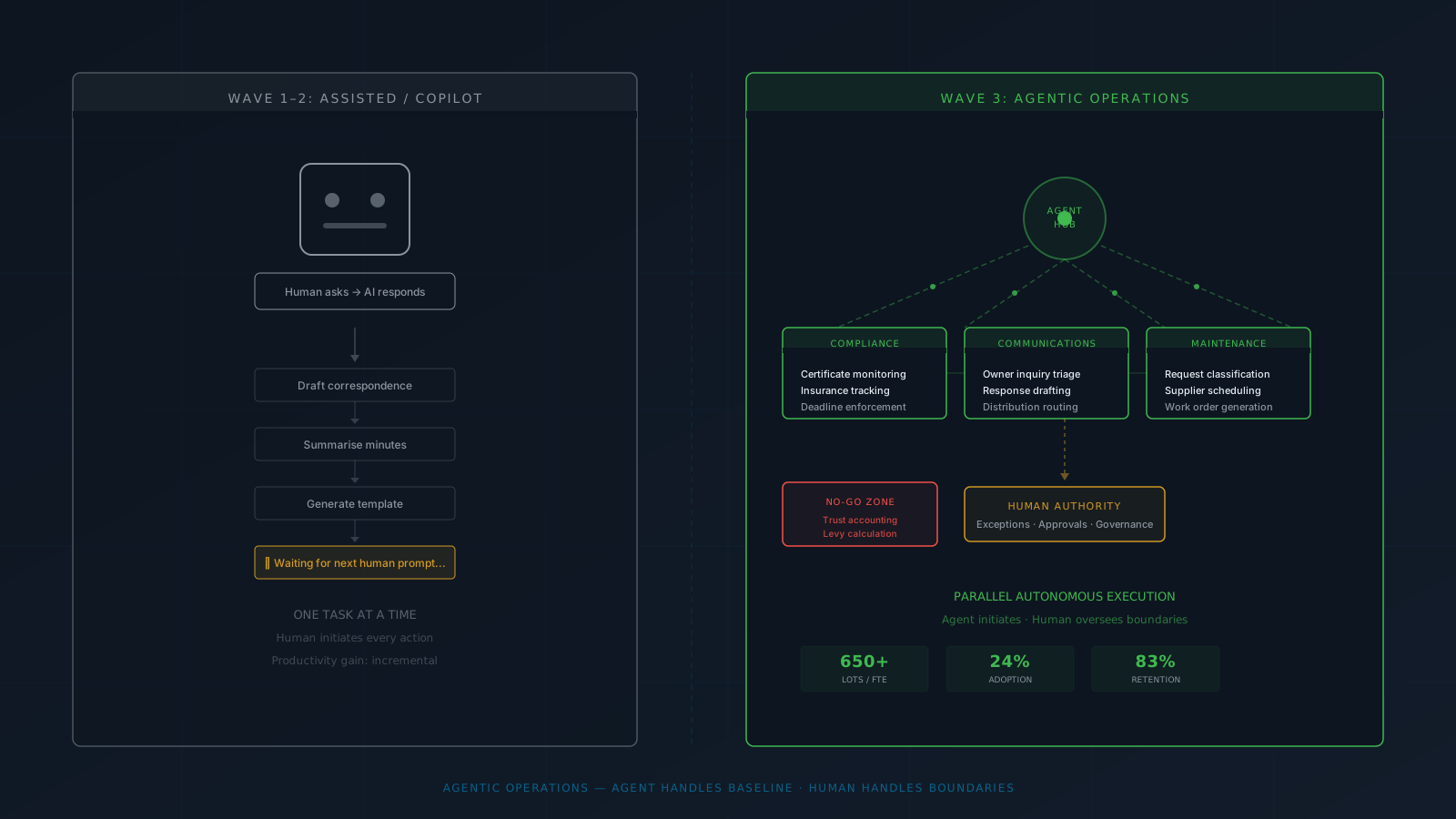
The Macquarie Bank 2026 Benchmarking Report confirmed what the conference circuit has been buzzing about: 80% of Australian strata businesses are now using AI tools. But buried in that headline is a more telling number, 24% are deploying AI agents. Not chatbots. Not copilots. Autonomous systems that execute multi-step workflows with minimal human oversight.
That 24% figure marks the beginning of a structural shift in how strata operations work. This article separates the signal from the noise on agentic AI in property management, maps where it creates genuine value in strata, and draws the line where it must stop.
The Three Waves of AI in Strata
To understand where the industry is heading, it helps to see where it has been.
AI Adoption in Strata, Three Waves
-
WAVE 1 (2023 to 2024)AssistedGenerative AI tools used for communication drafting, template generation, meeting minutes summarisation. The human initiates every action. AI suggests; the manager decides.Productivity gain: incremental · Risk: low · Adoption: broad but shallow
-
WAVE 2 (2024 to 2025)CopilotAI embedded into platform workflows, auto-classifying maintenance requests, drafting owner correspondence, flagging compliance deadlines. The human remains in the loop but the AI handles more of the preparation.Productivity gain: moderate · Risk: moderate · Adoption: growing among enterprise firms
-
WAVE 3 (2025 to 2026)AgenticAutonomous AI agents that execute complete workflows end-to-end. An agent receives a maintenance request, diagnoses priority from historical data, checks budget availability, generates a work order, contacts the preferred supplier, and schedules the job, without a human touching the workflow until the exception threshold is triggered.Productivity gain: transformational · Risk: requires architectural controls · Adoption: 24% and accelerating
The jump from Wave 2 to Wave 3 is not incremental. It is architectural. A copilot helps you do your job. An agent does part of your job. That distinction changes everything about how platforms are designed, how compliance is maintained, and how firms scale.
Where Agentic AI Creates Value in Strata
Not every strata workflow is a candidate for autonomous execution. The value map has clear boundaries.
Agentic AI Value Map, High Value: Automate Aggressively
-
AUTOMATEOwner inquiry triage and responseHigh volume, pattern-based, low statutory risk
-
AUTOMATEMaintenance request classification and routingHistorical data enables accurate priority scoring
-
AUTOMATESupplier invoice matching and AP processingRules-based matching against POs and contracts
-
AUTOMATEMeeting notice generation and distributionTemplate-driven with jurisdiction-specific rules
-
AUTOMATEInsurance renewal tracking and compliance certificate monitoringDate-driven, penalty-linked, audit-critical
Medium Value: Agent Prepares, Human Decides
-
PREPAREBudget preparation and levy settingFinancial authority requires committee approval
-
PREPAREWork order approval above thresholdExpenditure authority limits apply
-
PREPAREBy-law breach escalationLegal judgment and proportionality required
-
PREPARECommittee report draftingStrategic framing and relationship context
No-Go Zone: Deterministic Only
-
NO-GOTrust account reconciliationStatutory liability, zero-tolerance for error
-
NO-GOLevy calculation and apportionmentMathematical precision required by legislation
-
NO-GOSinking fund / capital works fund transfersRegulated fund movements with audit obligations
-
NO-GOAGM voting tabulationGovernance integrity, legal standing of resolutions
This last category is the critical boundary. As we wrote in February’s Deterministic vs Probabilistic, trust accounting and financial compliance require hard-coded rules engines, not probabilistic models. Agentic AI amplifies that principle. An autonomous agent that makes a trust accounting decision based on pattern matching rather than statutory rules is not just a risk, it is a potential breach of fiduciary duty.
The Economics of Agentic Operations
The Macquarie benchmarking data tells the economic story. The average strata business manages 415 lots per FTE, up 19% from 2022. Firms at the frontier are pushing well beyond that. But the 415 figure is an average, and averages mask the distribution.
Productivity Distribution, Lots per FTE
-
280 to 350Manual-heavy firmsHeadcount-dependent, low automation
-
415Industry averagePartial automation, some AI adoption
-
500 to 650Automation-led firmsWorkflow automation, Wave 2 AI
-
650+Agentic-ready firmsEnd-to-end autonomous workflows for Tier 1 tasks.The frontier: $180,000 to $250,000 annual salary savings per 10,000-lot portfolio vs industry average
The gap between 350 and 650+ lots per FTE is not explained by harder-working staff. It is explained by how much of the operational baseline runs without human intervention. Agentic AI is the technology that pushes the frontier from 500 to 650+, by eliminating the human touchpoints in high-volume, pattern-based workflows.
What the Platform Must Do Differently
An agentic architecture is not a chatbot with more permissions. It requires five structural capabilities that most strata platforms do not have today.
Five Requirements for Agentic Platform Architecture
-
1Deterministic GuardrailsEvery agent must operate within explicit authority boundaries. Financial thresholds, compliance rules, and governance constraints are hard stops. The agent handles the workflow up to the boundary. At the boundary, it hands off to a human. No exceptions, no overrides, no learned behaviours.
-
2Audit Trail by DefaultEvery action an agent takes must be logged with the same rigour as a human action. Who initiated the workflow? What data did the agent use? What decision did it make? What was the outcome? If you cannot audit an agent's decision chain, you cannot deploy it in a regulated environment.
-
3Exception EscalationAgents must know what they do not know. When a maintenance request doesn't match any historical pattern, the agent escalates, it does not guess. The quality of an agentic system is measured by the quality of its escalation logic, not by the volume of its autonomous decisions.
-
4Jurisdiction ParameterisationStrata regulation varies by state. An agent that sends a meeting notice must know whether it is operating under NSW, Victorian, or Queensland rules, and apply the correct notice periods, quorum requirements, and voting procedures. This is not a configuration setting. It is a runtime parameter.
-
5Human Authority PrimacyNo governance action without authorised human initiation. An agent can prepare an AGM pack, draft every notice, compile every financial report, and pre-populate every resolution. But the committee chair presses the button. This is not a limitation of the technology. It is a design principle that preserves the legal standing of every decision the scheme makes.
The Turnover Connection
The Macquarie data shows strata manager turnover at 24%, down from 33% in 2022, but still 60% above the national workforce average. The correlation between automation maturity and retention is not coincidental.
Firms where strata managers spend their days on owner communications, relationship management, and strategic advisory retain staff at 83%. Firms where managers spend their days chasing invoices, re-keying data, and assembling AGM packs retain staff at 76%.
Agentic AI does not replace strata managers. It replaces the parts of the job that drive people out of the profession. The 24% that are already deploying agents are not reducing headcount. They are retaining the headcount they have, and deploying it on work that justifies premium fees.
The Bottom Line
Agentic AI is not a feature. It is an operating model. The firms that deploy it successfully will manage more lots per head, retain more staff, and capture more margin, not because the AI is smarter, but because it handles the operational baseline while humans handle the exceptions, the relationships, and the decisions that carry legal weight.
The 24% adoption figure in the Macquarie report is a leading indicator. Within two years, agentic workflows will be table stakes for enterprise strata firms. The platforms that enable it, with deterministic guardrails, audit trails, and jurisdiction-aware agent logic, will define the next productivity frontier.